

What is Bulgarian food? It sounds simple. It never is. For a Bulgarian working in food this question comes loaded. I have to answer it on a daily basis to people who try to place me. It becomes that excruciating moment where you have to self-define. And every time I try, I fail a little. I get angry.
Maybe it’s better to admit that the answer is slippery. Bulgarian food, like the country itself, is certainly chaotic and contradictory. I’ve had to learn to lean into that chaos both creatively and destructively. It is central to my identity after all, so I will try to answer the question as well as I can through my own experience.
Outsider eye
For me, there has always been a distance since I moved away. Bulgaria hasn’t been my permanent home for 20 years now. I belong to a diaspora, the millions who took off for work, love, education or escape. I sometimes have the feeling Bulgaria is now defined more by the people who left than by those who stayed. The essence of home travels abroad, where it mutates, romanticises, reinvents itself. And yet Bulgaria is still rather unknown. I often find myself as the only reference point people have to the entire culture of Bulgaria.
Texture means life
What unsettles me most about modern Bulgaria isn’t change but uniformity. The global template: same cafés, same fonts, same playlists. The rough edges that made us who we were are being polished away. I often find myself repelled by what I can only describe as the generic. What I love, instead, is texture. Texture in design, in food and human behaviour. The slight imperfections that prove a person made this, not a system. A crooked pastry, a mismatched plate, a phrase said the wrong way.
Texture means life. Smoothness, to me, is death. I truly miss reading the clumsy translation of restaurant menus at Bulgarian tourist resorts. Those lost-in-translation moments brought quite the flavour, and mis-navigated customers through the Bulgarian culinary landscape. A journey now lost to perfected Google-translate models. I don’t believe Bulgarian food needs reinvention. It needs articulation. A confidence to stand in its own, at times a little chaotic, texture without asking for permission.
Internalised xenophobia
My first attempt at a restaurant pop-up was around 2012, as a newly graduated art student who somehow traded design work for a space in the then not fully gentrified Broadway market in East London. The idea was to serve the food I knew and contain it to a concept built around a traditional cooking vessel gyuceche (a small clay pot for one). It was supposed to be simple – I was to provide the concept, design and space while my chef friend was going to cook for a few days. Well things didn’t exactly go to plan. He had a last-minute change of heart and came to me with the words, “I don’t know what you’re thinking. Who’s going to eat this peasant food?”
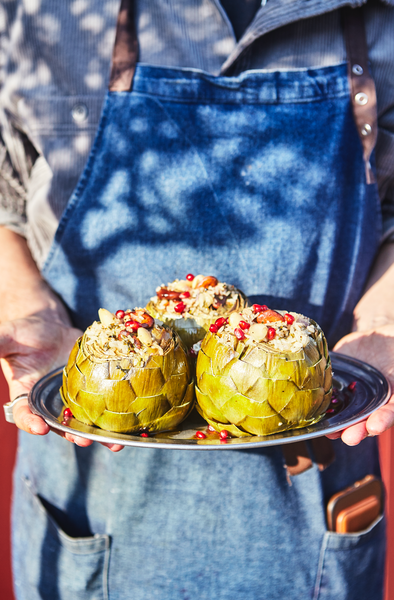
In Italy, cucina povera, the poor kitchen, is revered. In Bulgaria, peasant food is something to grow out of. That double standard fascinates me. Why is rusticity aspirational when it’s Tuscan but embarrassing when it’s Balkan? Our dishes are built from necessity: beans slow cooked to silkiness, roasted peppers peeled by hand, cabbage leaves rolled around rice and mince. The magic lies not in luxury but in humble ingredients bound by repetition, patience, skill and memory. Bulgarian food is survival turned into ritual.
Geography, history, identity
I must circle around geography, history, and how my own identity was shaped in the spaces between leaving and returning. Bulgaria sits in the middle of the Balkan Peninsula, literally cut in half by the Balkan mountain range (the Old mountain as we usually call it). Greece lies to the south, Turkey to the east, Serbia and North Macedonia to the west, Romania beyond the Danube to the north. The Danube matters. So many influences, like layered cakes, Austrian schnitzels and other respectable city foods, floated downstream with trade and empire.
When I talk about Bulgarian food, I often slip into saying Balkan food instead. The region’s borders have shifted so often that culinary identities blurred long before anyone started drawing modern maps. Recipes travelled over mountains and through wars. To cook in the Balkans is to accept that ownership is collective, porous, and most certainly disputed.
Culture flow, linguistics, export
The Ottoman Empire ruled the region for five centuries, and its imprint remains in the shape of stuffed vegetables and meze-rich tablescapes. At the same time, the Danubian north absorbed Central European habits. Food has never respected borders, and yet way too often I am confronted with Bulgarians rejecting the existence of their own food culture. A shortsighted stance. Perhaps the linguistic dominance of the Empires contributes to this hypothesis with their extensive lexicon of dishes. It seems much more plausible that culinary knowledge flows both ways from conqueror to the peripheries, and vice versa. Our neighbours have börek; we have banitsa. They make ajvar; we make lyutenitsa. The differences are tiny but linguistic, and they matter. Bulgarian words don’t travel easily. They twist tongues, they resist export. You can market hummus or souvlaki while snezhanka still sounds foreign even three syllables in. It is a branding challenge that I have myself faced in my work many a time. Including my own name for starters. Most recently I started to discover beauty in this “hurdle” and recognise it as step away from sanitation and the slippery road into complete cultural homogenisation. We write in our own Cyrillic alphabet, which makes us look invisible to Western eyes and thus harder to simplify.
When I cook abroad, I am translating. Ingredients change but memories persist. I hold my mother’s stories so dearly that sometimes they corrupt my own recollections. I lose track and mix them up with my own lived experiences. But it truly doesn't matter. What emerges is not Bulgarian food as it was, but as it could be a version shaped by longing and reinterpretation.
Ingredients of greatness
There is a Bulgarian word that captures a national neurosis: chuzhdopoklonnichestvo. It means “bowing to the foreign.” Take the Michelin Guide. Almost every culinary conversation I have in Bulgaria includes that question: “When will Bulgaria get a Michelin star?” As if the cuisine will suddenly become better, more refined, more real once a French institution deems it worthy. It’s wild. I find it almost tragic that we still measure our worth through someone else’s lens. Caroline Eden, who has written deeply about the region, once asked me: …what was that wonderful phrase, in Bulgarian, for romanticising foreign things? It’s the perfect description of a country that doubts itself, even in its own kitchen. We have all the ingredients of greatness, yet we’re constantly waiting for someone else to tell us so. This need to please, to conform, blinds us to our own qualities.
Contrary to many outsider assumptions, Bulgarian food isn’t about meat and potatoes (I think often clumped together with Northern Slavic’s reputation). From the salads that are simply a centrepiece of socialising on the summer table, via the cooked “postno” food for Lent period, through to the preparation of zimnina, processing and jarring vegetables for the winter. In the Bulgarian psyche forever lives the image of the pink garden tomato; and believe me we are happy to challenge any other southern European to a Tomatina -fight over it.
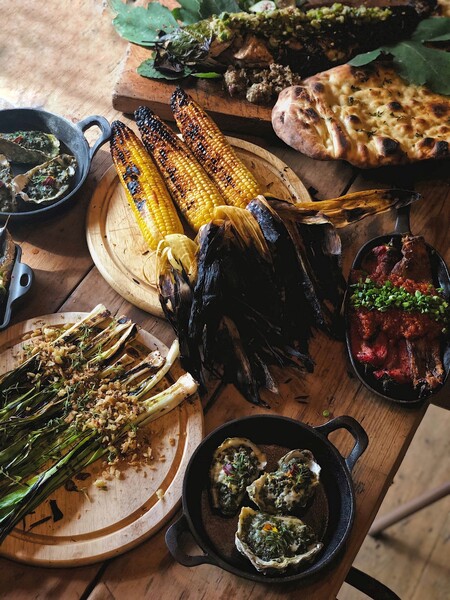
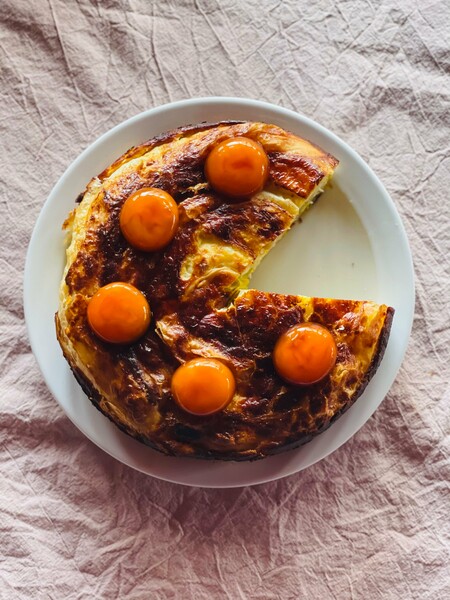
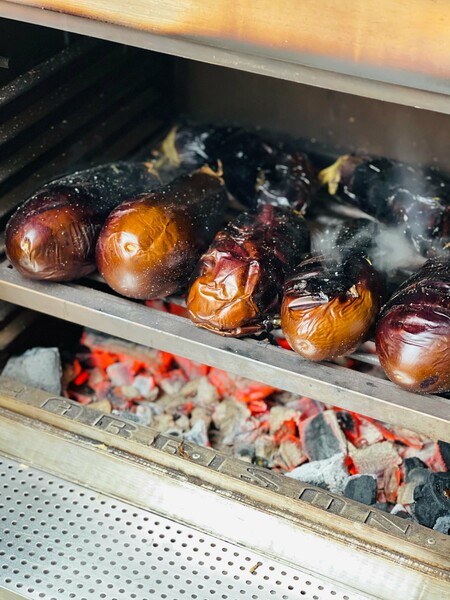
Bulgarian food is earthy, natural, sometimes a little messy, a little out of control. If you want to know its flavour, start with bacteria and smoke. Fermentation is everywhere – yogurt, cheese, pickles, rakia, cabbage. Wild cultures misbehave in the most beautiful way. They bubble and spill, they change daily. Our microbes have character. Then there’s fire-touched peppers blistering, eggplants collapsing, meats slow grilled.
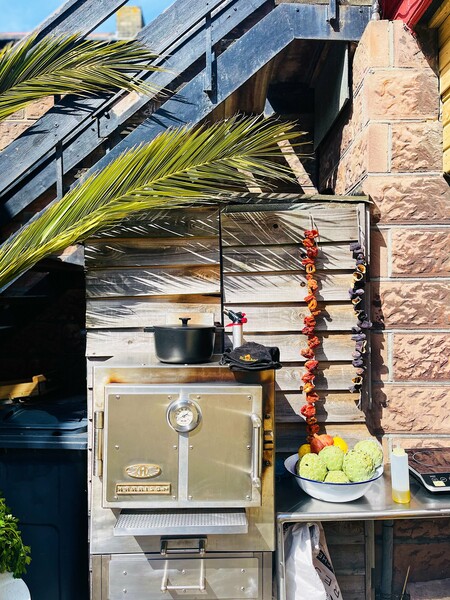
Born from the need to tame fire and bring it indoors (the rural population migrated to communist council blocks in hordes) is our national appliance, the chushkopek. The contraption is a stone-lined metal kiln designed for one purpose – roast peppers and aubergines at 1,000 degrees. I often compare it to the rice cooker as it is humble, functional and shared cultural shorthand. You know a household by whether it has one.
And of course, yogurt. Everyone mentions lactobacillus bulgaricus. When people ask what Bulgaria invented, I jokingly say “yogurt.” But of course, we didn’t invent it; we named it. It existed long before us, just as America existed before it was “discovered.” Yet in the act of naming, we claimed belonging. Yogurt is our accidental flag. And yet despite all that, the burgers of the world are pushing right in there bringing the West to the table.
My Balkan food
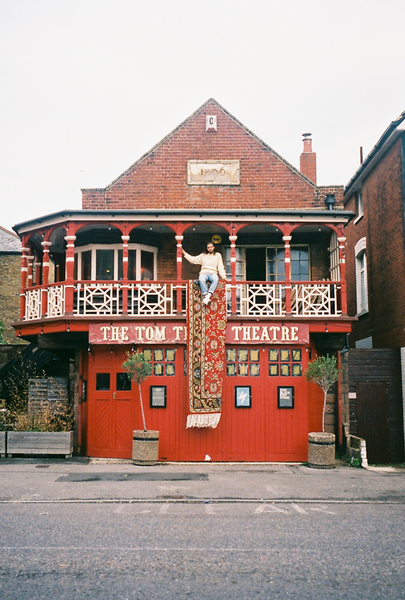
When I think of the future of Bulgarian food, I imagine something both grounded and free. In 2021, I nearly accidentally created my own expression of culinary and cultural identity through Dolma Bar. My own universe of de-integration at the English coast. A concept that was often mistaken both by Balkan folk and outsiders for an authentic category of restaurants. Almost expecting to go to Sofia, Belgrade or Bucharest perhaps and be greeted by a restaurant specialising in dolmas and samas (wrapped and stuffed dishes, most popular of which are vine leaf and cabbage rolls) on every corner. In reality it was a reimagined culinary jigsaw I’ve put together. To me, it’s not about copying the past; it’s about intention. Cooking with memory, not from it, is where the future is.





